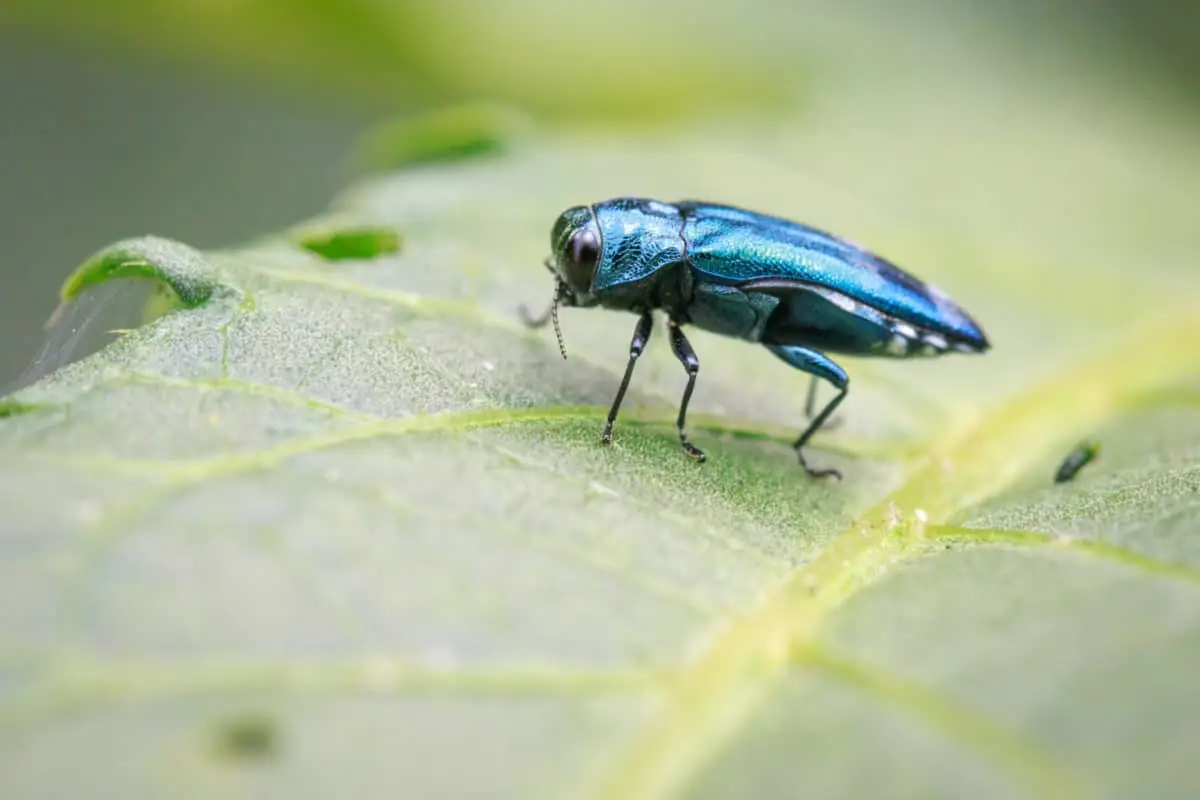
Emerald ash borer (EAB) is the most destructive forest pest in North American history. Since its accidental introduction from Asia in the early 1990s, EAB has killed an estimated 100 million ash trees across North America (Canadian Forest Service, 2023). In Ontario alone, the economic impact exceeds $7–8 billion when timber, urban forestry, and ecosystem losses are combined (Ontario Ministry of Natural Resources, 2022). EAB is now confirmed throughout Simcoe County — if you have ash trees on your property, EAB is a real and immediate threat.
The challenge with emerald ash borer is that visible symptoms often don't appear until an infestation is already 2–3 years old and the tree is significantly compromised. By the time most homeowners notice a problem, EAB has already disrupted the tree's vascular system. Here are the five most reliable signs to look for.
1. Crown Dieback
One of the most noticeable signs of EAB infestation is thinning or dieback in the tree's upper crown. EAB larvae feed on the phloem and cambium layer beneath the bark, girdling the tree's vascular tissue and cutting off the flow of water and nutrients. This typically progresses from the top down — by the time the mid and lower crown are affected, 30–50% of the tree's vascular system has already been destroyed.
2. Bark Splitting and Vertical Cracks
As EAB larvae feed beneath the bark, they create stress fractures that cause the bark to split vertically. These splits may appear on the trunk or major branches and are often accompanied by callus tissue growth as the tree attempts to heal. Bark splitting caused by EAB tends to be accompanied by the other signs listed here — if you see it alone, it may have another cause.
3. D-Shaped Exit Holes
Adult EAB beetles chew through the bark when they emerge in late May through July, leaving behind a distinctive D-shaped exit hole approximately 3–4mm across — roughly the size of a pencil eraser. This D-shaped profile is diagnostic for EAB; other wood-boring beetles leave round or oval holes. Check the bark of suspected trees carefully, as exit holes can be small and easy to miss.
4. S-Shaped Larval Galleries
EAB larvae feed in winding, S-shaped patterns through the cambium and phloem layer just beneath the bark. These galleries are visible when the bark is peeled back and are packed with frass (a mixture of excrement and wood particles). The galleries cut across the tree's vascular system, which is why EAB is so lethal — even a moderate infestation can girdle and kill a tree within 3–5 years.
5. Increased Woodpecker Activity
Woodpeckers are highly effective at detecting EAB larvae beneath bark and will aggressively excavate infested trees. This 'flecking' or 'blonding' — where large patches of bark are removed — is one of the most visible early indicators of EAB and often appears before other symptoms become obvious. Unusual woodpecker activity on an ash tree should always trigger an inspection.
What to Do If You Suspect EAB. Early detection dramatically expands your options. According to the Ontario Ministry of Agriculture, Food and Rural Affairs, systemic insecticide treatments (primarily emamectin benzoate injected into the trunk) are 85–90% effective at protecting ash trees when applied before the infestation reaches the upper crown. Once more than 50% of the crown is affected, treatment is generally not recommended and removal is the safest course. Contact a certified arborist for an assessment as soon as you notice any of these signs.